Thang-Ta — Ritual, Dance and Combat, With None of Them Hiding the Others
Manipur's sword and spear art is practised as ritual, as dance and as combat — all three openly, and none of them as a disguise.
Contents
Overview
Thang-Ta is the common name for the martial art of the Meitei kingdom of Manipur in north-east India. It says plainly what it is: thang is the sword, ta the spear.
The older and wider name is Huiyen Lallong (also Huyen Langlon) — huiyen means war, lallong, depending on the reading, net, knowledge or art. Under that roof stand two halves:
- Thang-Ta — armed combat
- Sarit Sarak — the unarmed part, with hand and leg techniques and the grappling mukna
But the reason this article was written is a different one. Thang-Ta is practised in three ways at once — as ritual, as demonstration and as combat. And the British colonial power banned it in 1891.
The two together make this case valuable, because it refutes an expectation this stock examined only yesterday somewhere else.
Three ways of practising the same art
| Level | What it is |
|---|---|
| Ritual | a tantric-inflected practice, entirely ceremonial |
| Demonstration | sword and spear dances, convertible into fighting practice |
| Combat | the actual application |
This threefold division is not a story of decay. It is not to be read as a real fight that first became a dance and then a ceremony. The three stand side by side, and practitioners move between them.
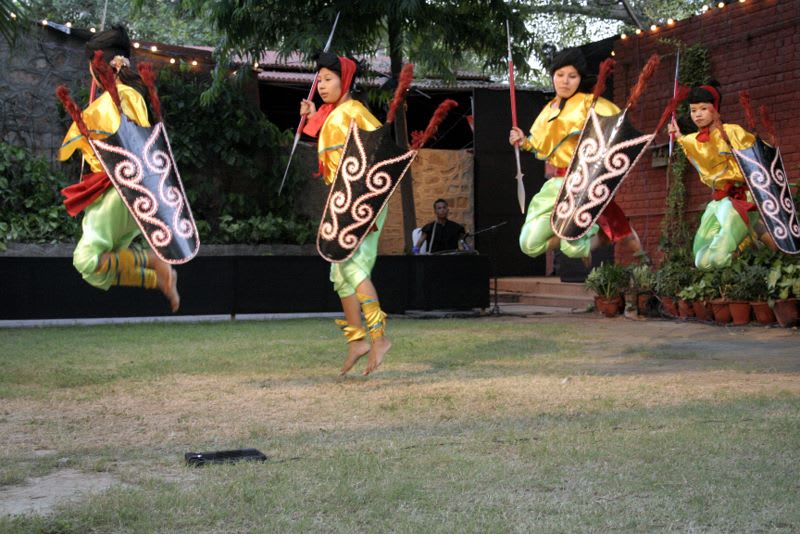
The dance side has names of its own: thang-hairol is the sword dance, khousarol the spear dance, and the sacred thenkou dance was traditionally performed by martial artists.
And it has not remained a side matter. Huiyen Lallong is among the roots of Manipuri, one of the Indian classical dance forms recognised by the Sangeet Natak Akademi — together with the Lai Haraoba festival, the Meitei Nata Sankirtana and the Raaslila.
The weapons
| Weapon | Description |
|---|---|
| Thang | the sword |
| Ta | the spear — handled at close range or thrown |
| Chungoi | a leather shield, about a foot across |
| Cheibi | a leather-covered cudgel, about two feet |
| also | the axe |
The cheibi is why this article points to the stick fighting comparison. A two-foot leather-covered stick in one hand and a small shield in the other is exactly the build the comparison describes for gatka, where the soti is carried beside the farri shield.
Only the cheibi here is not a blade substitute but the competition weapon. You strike with the stick because you cannot practise with the sword — and that is a different answer from making the stick a stand-in for the sword in the technique.
What the sources give
For the early period there is written material, which in this part of the world is not to be taken for granted.
The puya, records in the old Meitei script, include in the Chainarol-Puya a text on the ethics of the duel. Beside it stand details of military organisation:
| Period | What happened |
|---|---|
| 1074–1122 | King Loiyamba Shinyen institutes the lallup levy |
| 1404–1432 | King Punshiba creates a permanent military department |
| 1709–1748 | Meidingu Pamheiba expands the lallup: every man over 16 serves the state 90 days a year, with martial arts training |
The last row is the most revealing. Ninety days a year, for every man over sixteen — that is not a warrior caste and not secret knowledge but general military preparation of a small state. Whoever trains like that needs an art that many people can learn.
1891
And then comes the date that changes everything.
In the Anglo-Manipuri War of 1891 Manipur was defeated and annexed to the British Empire. The Manipuri army had fought so well that the colonial power drew a conclusion from it:
It made possession of weapons illegal and outlawed the martial arts of Manipur — thang-ta included.
The ban held until 1947. The art went underground and was kept alive by a few experts. In 1934 Maharaja Churachand took it up again; after Indian independence it slowly came back.
A ban justified by the effectiveness of a martial art is rare and telling. The stock knows comparable cases: the capoeira article records the Brazilian ban of 1892 — one year after Manipur — and ssireum carries the suppression during the Japanese occupation of 1910–1945.
Why no disguise story came of it
And here is this article’s actual yield.
The obvious narrative would be: banned, therefore disguised as dance. That is precisely the narrative capoeira has carried for decades, and this stock examined it yesterday at engolo and marked it as an interpretation — the Angolan material points rather to the closeness of game, fight and dance being a shared grammar than a ruse.
Thang-Ta is the independent control case, and it comes out the same way.
Here all the ingredients for the disguise story are ready to hand: a hard, dated colonial ban, a pronounced dance form, survival in hiding. And still nobody tells the story that thang-hairol was invented to deceive the British. The dance forms are older than the ban, they have their own names, their own occasions and their own place in the ritual — and they have gone into a recognised classical dance form.
The conclusion one may draw: a ban does not automatically produce a disguise. Where fight and dance use the same movement language anyway, the ban has nothing to invent — it merely shifts which of the three levels is shown in public.
Competition today
Fighting takes place in a circle of about thirty feet, in two forms:
| Form | Rules |
|---|---|
| Phunaba ama | two rounds of three minutes, with cheibi and shield |
| Phunaba anishuba | the same format, but without the shield and with kicks |
The second form is the more interesting, because it shows how the two halves belong together: take away the shield and the leg comes in. Sarit sarak is not a separate art but what remains, and steps in, once the equipment falls away.
Today
Thang-Ta is practised by men and women and counts as the most widespread of the Meitei martial arts. Competitions are held yearly at school, district, state and national level; the largest training institution is the Huyen Langlon Thang-Ta Academy. Beyond Manipur the art is promoted across India, among other places in Jammu and Kashmir, and taught both as a sport and as self-defence.
Gurumayum Gourakishor Sharma, one of its leading exponents, received the Padma Shri in 2009.
The setback did not come from the ban alone. After the Second World War the transmitted practices receded further through modernisation and missionary activity — the same combination that in jogo do pau is called rural depopulation and firearms. A ban rarely ends an art by itself; it weakens it, and change does the rest.
Common fallacies
“Thang-Ta is dance.” It has a dance level, beside a ritual and a fighting one. Whoever sees only the thang-hairol sees a third.
“The dance is the disguise of the fight.” There is no evidence for that here — and the case would be ideal for it if there were. The dance forms are older than the ban of 1891.
“It is an unbroken transmission.” Between 1891 and 1947 the art was under penalty, and after 1945 it receded further. What is practised today was fetched back — with the advantage that bearers were still alive.
“Sarit sarak is a separate martial art.” It is the unarmed half of the same art. The competition shows it: without the shield, the kicks come in.
“The cheibi is a substitute sword.” It is the competition weapon. You strike with the stick because you cannot practise with the sword — which is something other than handling the stick technically like a blade.
Related Articles
- Kalaripayattu — the other great Indian art with a weapons and a healing part
- Silambam — the Tamil stick art, the long staff of the stick fighting comparison
- Gatka — stick plus small shield, but as a blade substitute rather than a competition weapon
- Bando — the Burmese neighbour whose predecessor field points to India
- Jogo do Pau — the same combination of ban, decline and recovery, in Portugal
- Stick Fighting Compared — where the cheibi would be placed
- Capoeira — the ban of 1892, a year after Manipur, and the question of disguise
- Engolo — where the same question about game, fight and dance is examined
- Ssireum — suppression by an occupying power and revival afterwards
- Malla-Yuddha — Indian wrestling, kin to the mukna of sarit sarak