Wrestling — The Oldest Form of Combat
Wrestling is the most widely attested form of combat in human history — today Olympic in freestyle and Greco-Roman, and the most effective base for MMA.
Lineage
Contents
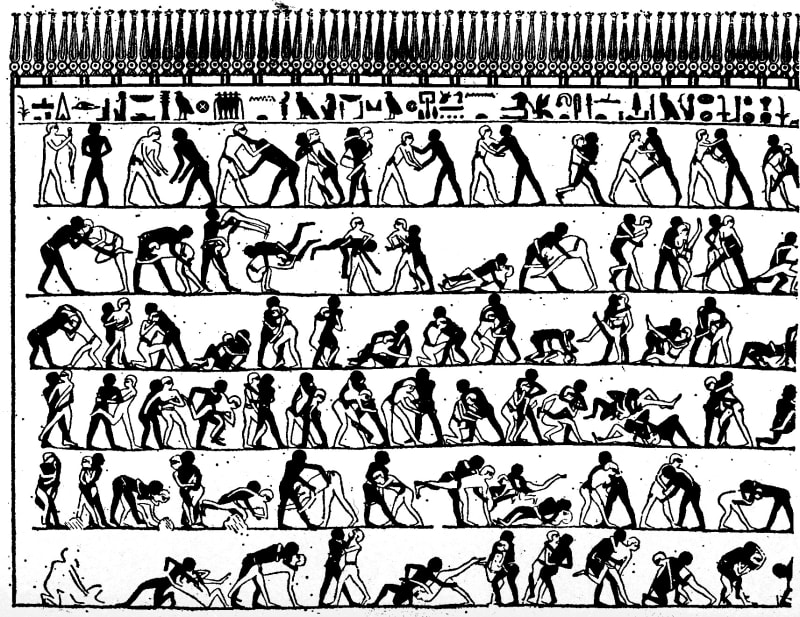
Wrestling has the broadest documentary record of any form of combat. There is scarcely a culture that did not produce its own wrestling tradition — from the Egyptian tomb at Beni Hasan through the Greek palé to ssireum, schwingen and pehlwani. The reason is both banal and profound: two people trying to overcome each other without weapons and without intent to kill will almost inevitably arrive at gripping, lifting and taking down.
The modern sport has two Olympic styles. Greco-Roman prohibits any attack below the waist and any use of the legs — wrestling happens entirely with the upper body. Freestyle permits both and is technically more open. Victory comes by pinning the shoulders (fall), by technical superiority, or on points. What distinguishes wrestling from most other martial arts is the complete absence of strikes and submissions: it is solely about control over the opponent’s position. That very specialisation is what makes it the single most consequential skill in modern MMA.
History
Wrestling is archaeologically attested earlier than any other martial art. The wall paintings at Beni Hasan in Egypt depict several hundred wrestling sequences around 2000 BCE — an instructional manual in pictures. Sumerian reliefs and the Epic of Gilgamesh know wrestling too.
In Greece, palé became an Olympic discipline in 708 BCE and was also the decisive event of the pentathlon. Bouts were contested standing; three throws decided them. Its harsher sibling was the pankration, which combined wrestling with striking.
The modern sport grew from two separate roots:
| Strand | Origin | Character |
|---|---|---|
| Greco-Roman | France, 19th c. | a deliberate reconstruction of an “ancient” ideal; upper body only |
| Freestyle | England and the USA, 19th c. | out of the fairground catch as catch can; leg attacks permitted |
Greco-Roman featured at the first modern Games in 1896. Freestyle was added in 1904 at St Louis, where in the event only Americans competed. After an absence in 1912, freestyle has been continuously Olympic since 1920. The world federation — today United World Wrestling — dates from 1912; it issued a first unified freestyle ruleset in 1921. Women’s freestyle became Olympic only in 2004 at Athens.
The most recent turning point came in 2013: in February the IOC unexpectedly recommended dropping wrestling from the 2020 programme. The federation responded with an unprecedented campaign — rule changes, new leadership, more weight classes for women, a symbolic tournament at ancient Olympia. On 8 September 2013 the IOC voted in Buenos Aires to reinstate the sport. The episode is regarded as an object lesson in how quickly even a founding sport can lose its Olympic place.
Technical Foundations
Bouts are contested on a mat at least nine metres across and run two periods of three minutes. A bout ends early by fall, when both of the opponent’s shoulders are held to the mat, or by technical superiority at a set points margin.
| Area | Content |
|---|---|
| Standing | handfighting, leg attacks, throws, stance |
| Ground (par terre) | turning the opponent onto the shoulders, holding, defending |
| Points | 1–5 depending on technique; high-amplitude throws score most |
| Passivity | penalised — the sport compels attacking |
The decisive difference from every other grappling art: there are no submissions. A wrestler cannot force an opponent to give up, only overcome them. A wholly different risk profile follows — wrestlers learn to stay in positions a BJJ player would have to leave long before, because there a submission would threaten. In MMA that is sometimes a strength and sometimes a liability.
A third style, folkstyle, is practised in American schools and colleges. Unlike freestyle it rewards sustained control on the ground (riding time), which makes it technically closer to MMA ground work than the Olympic variants.
Core Techniques
- Double leg — grasping both legs and driving through. Statistically the most common takedown, and the technique every MMA defence is built against first.
- Single leg — attacking one leg, possible from greater range and more flexible to follow up.
- Sprawl — the base defence: throwing the legs back and dropping weight onto the attacker’s back.
- Suplex and arching throws — high throws over the bridge, the most spectacular score in Greco-Roman.
- Gut wrench and leg lace — turning techniques on the ground that roll the opponent repeatedly across the shoulders; the fastest source of points in par terre.
- Handfighting — the constant contest for grips and for head and wrist control, from which all attacks emerge. The least visible part to spectators and the most important to wrestlers.
Philosophy
Wrestling has no transmitted doctrine, no equivalent to budō. What it has is an exceptionally hard training culture that looks nearly identical across the wrestling nations — Iran, Russia, Turkey, Georgia, the United States and Japan. Its core is the experience that in wrestling nobody gets hit and still loses: defeat is unalloyed and cannot be attributed to bad luck or a single blow.
Culturally, wrestling is a national sport of considerable symbolic weight in several countries. In Iran, koshti pahlavani is closely bound to the zurkhaneh and its ethical ideal of the pahlavan — strength that shows itself in humility. In Turkey, the oil wrestling of Kırkpınar is among the oldest continuously held sporting contests in the world.
Styles and Schools
| Style | Legs permitted | Distribution |
|---|---|---|
| Freestyle | yes | Olympic, worldwide |
| Greco-Roman | no | Olympic, strong in Europe |
| Folkstyle | yes | USA, school and college |
| Beach wrestling | yes | sand ring, promoted by the world body since the 2000s |
Alongside these stand the traditional wrestling styles, each forming its own competitive culture: ssireum in Korea, schwingen in Switzerland, pehlwani in South Asia, glima in Iceland, sumo in Japan, and kurash, kuresh and Mongolian bökh.
Connections to Other Martial Arts
- Catch wrestling — grew from the same catch as catch can as freestyle, but kept submissions
- Sambo — the Soviet synthesis of judo and the wrestling styles of the Soviet republics
- MMA — wrestling determines where the fight happens and is statistically the most successful background
- BJJ — complementary: wrestling puts the opponent on the ground, BJJ finishes the fight there
- Judo — a related throwing system, but gripping the jacket rather than the body, which changes the whole mechanics
- Pankration — the ancient union of wrestling and striking
Today
Wrestling is organised in over 180 countries and firmly established as an Olympic sport — with the caveat 2013 made visible. Iran, Russia, Japan, the USA, Georgia and Azerbaijan dominate competitively; in the women’s field, chiefly Japan and the USA.
Its open problems are those of a sport rich in tradition and poor in marketing:
- Visibility and money. Despite Olympic status there is barely a viable professional structure. Many elite wrestlers move into MMA after their careers — not out of sporting interest but because an income is possible there.
- Weight cutting. The practice of acute dehydration is older in wrestling than in MMA and cost three American college wrestlers their lives within weeks in 1997. The NCAA minimum-weight and hydration rules introduced in response are still regarded as a model, but are not universally standard internationally.
- Rule complexity. Scoring rules have been changed repeatedly since 2013 to make the sport more watchable. Whether this has succeeded is judged differently within the sport.
As a training base, by contrast, wrestling is in greater demand than ever: practically every serious MMA gym now employs a wrestling coach, and by that route the technique has reached a distribution the competitive sport alone would never have achieved.
Related Articles
- Greco-Roman Wrestling
- Catch Wrestling
- Brazilian Jiu-Jitsu
- Sambo
- MMA
- Judo
- Ssireum
- Schwingen
- Breakfalls Compared — why wrestling alone has no breakfall curriculum
- Throwing — One Principle, Seven Rule Sets — throwing without fabric — what anatomical grips allow
- Freestyle Wrestling — the Olympic style that permits attacking the legs
- Koshti Pahlevani — the Iranian branch, and why it manages without a points system
- Bare-Knuckle Boxing — the cross-buttock in prizefighting — throws were legal until 1867
- Footwork Compared — the absolute ban on crossing, and why it needs no rule