Kosen Judo — Not the Ancestor of BJJ but Its Sibling
Maeda left Japan in 1904; the Kosen tournament began in 1914. Kosen judo cannot have produced BJJ.
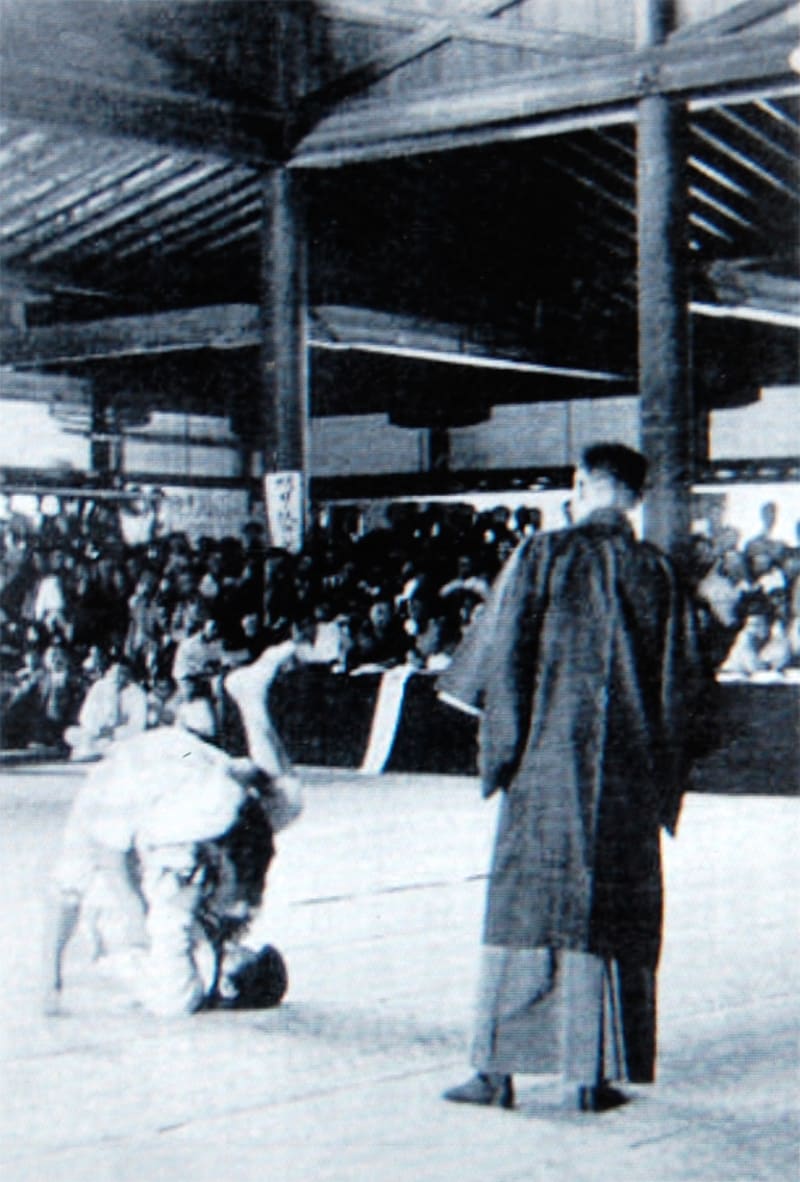
Lineage
Origins
Contents
Kosen judo (高專柔道) is not a martial art of its own and not a style. It is a ruleset. It arose at the kōtō senmon gakkō, Japan’s higher technical colleges, and differs from competitive judo in a handful of points — all of which push the same way: the bout may go to the ground at once and stay there.
This article is here because a claim hangs on Kosen judo that one reads everywhere and rarely sees checked: that it produced Brazilian jiu-jitsu. This site has carried that claim itself until now; the judo article stated that Kosen judo directly influenced the development of BJJ.
The claim fails on a date. Mitsuyo Maeda left Japan on 16 November 1904. The Kosen Taikai — the tournament out of which the Kosen rules and the whole tradition grew — was first held in 1914, ten years later. Maeda cannot have carried away what did not yet exist when he sailed.
What is true instead is more interesting than the legend: Kosen judo and BJJ are siblings, not ancestor and descendant. Both arise when you take the judo of around 1900 and remove the rules that force the fighters back onto their feet. That happened twice independently, once in Japan and once in Brazil.
What “Kosen” refers to
Kosen is short for kōtō senmon gakkō, “higher technical school” — technically oriented colleges for students roughly between 15 and 20. The name of the art therefore comes not from the art but from the type of school. That is more than a footnote: Kosen judo has been university-and-college sport from the start, with everything that entails — fixed year-groups, team competitions between schools, an audience of fellow students.
The key dates:
| Year | Event |
|---|---|
| 1898 | first judo competitions at the kosen schools |
| 1914 | first Kosen Taikai, the annual inter-collegiate competition |
| 1944 | last Kosen Taikai |
| 1950 | the kōtō senmon gakkō system is abolished under post-war education reform |
| 1952 | the seven former Imperial Universities found Nanatei Jūdō and adopt the Kosen ruleset |
The rules — and what follows from them
The Kosen rules were essentially those of the Dai Nippon Butokukai and the Kōdōkan before the changes of 1925. They differed on a few points, and every one of them concerns the transition to the ground:
| Kosen judo | modern competition judo | |
|---|---|---|
| Pulling to the ground (hikikomi) | permitted, without a preceding throw | forbidden or penalised |
| Time spent on the ground | unlimited | stood up for inactivity |
| Grips on the leg and the trousers | permitted | forbidden |
| Defensive posture | unrestricted | penalised |
| Outcome | victory by ippon only | scored, with graded scores |
The last point is often overlooked and is the most consequential. Where there are no points, there is no incentive to nurse a narrow lead through the clock. A bout nobody can win on points is either decided or drawn — and with that, the entire body of tactics that shortens groundwork in modern judo disappears.
This is precisely the mechanism the throwing principles comparison describes: technique does not determine the rules, the rules generate the technique. Kosen judo lets you watch it happen within a single family. Same people, same school, same founder — and a different contest, because four rules read differently.
The finding is a date
The chain usually told runs: Kosen judo → Maeda → Carlos Gracie → BJJ. It breaks at the first link.
- Maeda (1878–1941) trained at the Kōdōkan and was sent abroad by Kanō Jigorō as a representative of judo. He left Yokohama on 16 November 1904 and reached New York on 8 December 1904. He came to Brazil from 1914, and there taught the Gracies.
- The Kosen Taikai began in 1914, the same year Maeda reached Brazil — and ten years after he left Japan.
That settles it: what Maeda carried away was not the ne-waza of a tournament that did not yet exist. He carried the ne-waza of the Kōdōkan of his own day — and that was far more ground-oriented than the judo everyone knows today.
One objection is legitimate and belongs here: wrestling was already going on at the kosen schools from 1898, that is, during Maeda’s Kōdōkan years. He may have encountered the milieu. But a milieu is not a tradition. What is now called “Kosen judo” — the ruleset, the tournament form, the repertoire — came into being with the Taikai, and the Taikai came after he had gone.
Where the ne-waza did come from
If not from the Kosen tournament, then from where? From the Kōdōkan itself, which around 1900 gave groundwork far more room than it does now. The usual explanation is its encounters with jūjutsu schools specialising in ground work; the name almost always given is Tanabe Mataemon of the Fusen-ryū, who repeatedly beat Kōdōkan men on the ground, including with a leg lock at a demonstration before the crown prince in 1900.
That story should be passed on with reservations. Accounts of the matches between the Kōdōkan and the Fusen-ryū differ, and the sharpened version — that the Fusen-ryū taught the Kōdōkan groundwork — is not supported among historians. Ne-waza looks more like Tanabe’s personal speciality than a mark of his school; the Handa dojo is also named in this connection. What holds is the more modest statement: around 1900 groundwork was a live issue in Japanese judo, and there were specialists better at it than the Kōdōkan’s representatives.
But that is exactly what yields this article’s argument. If ne-waza was widely present around 1900, then neither Kosen judo nor BJJ needs the other as an explanation. Both draw on the same stock — and both develop it, because neither cuts the ground phase short artificially.
A correction to this site’s own material: the judo article here has until now claimed that Kosen judo influenced BJJ, and in the English version “directly”. That is irreconcilable with the date of Maeda’s departure, and it has been put right along with this article.
After 1950: Nanatei Jūdō
The education reform of 1950 abolished the school type, and the ruleset could have vanished with it. Instead, in 1952 the seven former Imperial Universities — Tokyo, Kyoto, Tōhoku, Kyūshū, Hokkaidō, Osaka and Nagoya — took it over and have staged Nanatei Jūdō (七帝柔道, “judo of the seven imperials”) ever since. The University of Tokyo withdrew in 1991 and rejoined in 2001.
So the tournament has run without interruption for over seventy years, but is contested almost exclusively by students of those seven universities. It is thus one of the few martial arts traditions whose survival depends not on schools, federations or masters but on student clubs — and which is therefore barely visible outside its own circle.
The direction of influence is the other way round
The most telling evidence against the descent story is how Kosen judo became known in the West at all. It was not discovered by people tracing the origins of BJJ. It became known because BJJ practitioners in the 1990s came across something that resembled their own ground game and began asking what it was.
Attention therefore ran from BJJ to Kosen judo, not the other way — interest from resemblance, not from descent. Anyone asserting a lineage inverts the actual order of rediscovery.
And the resemblance is real. Both work from the back, both treat the guard as a working position rather than a defeat, both go to the ground voluntarily. That is no accident, and no proof of kinship in the sense claimed — it is what two systems have in common when they have deleted the same rule from the same starting material.
The second case: Luta Livre
The same attribution attaches to Brazilian Luta Livre, and it deserves the same caution. Euclydes Hatem (“Tatu”, 1914–1984) trained in Rio de Janeiro from 1928; the standard account calls his system a mixture of catch wrestling and Kosen judo groundwork.
The teachers actually recorded by name, however, are catch wrestlers: Hatem trained at the YMCA in Rio under Orlando Américo da Silva (“Dudú”) and Manoel Rufino dos Santos. No kosen-trained teacher is named anywhere in the accounts. The attribution is therefore not refuted — it is unsupported, and that is a difference this article keeps open rather than resolving it one way or the other.
Connections to other martial arts
- Judo — the trunk. Kosen judo is not a defection from judo but judo under a particular version of the rules, preserved at a particular type of school.
- BJJ — the sibling, not the child. Both systems came out of the judo of around 1900, independently and in different countries.
- Luta Livre — the second case of the same attribution, on the same evidence.
- Jūjutsu — the nineteenth-century groundwork specialists from whose orbit came the ne-waza the Kōdōkan absorbed around 1900.
- Catch wrestling — the Western parallel: likewise groundwork without a stand-up rule, likewise in the same decades, and with no connection to Japan whatsoever.
- Throwing principles compared — Kosen judo is the evidence from inside a single art: same school, same founder, four different rules, a different contest.
Today
Nanatei Jūdō continues to be held, essentially by the student clubs of the seven universities. Outside Japan there is no widespread provision; anyone wanting to practise under Kosen rules will most likely find them in BJJ and submission-grappling circles that take them up as an additional format — which confirms the direction of attention described above once again.
Two notes for placing an offering. First: Kosen judo is a ruleset, not a curriculum. A course selling it as a style of its own with its own belt system and its own lineage is selling more than the subject supports. Second: beware promises about origins. Where something is advertised as “the root of BJJ”, a descent is being asserted that the calendar will not bear.
The real value lies elsewhere, and it is considerable: Kosen judo preserves a version of judo that competitive practice regulated away step by step — and it shows, in an example you can write down in four lines, how strongly a ruleset shapes a martial art.
Related articles
- Judo
- Brazilian Jiu-Jitsu
- Luta Livre
- Jūjutsu
- Catch Wrestling
- Throwing Principles Compared
- Euclydes Hatem — the person the open attribution hangs on — with the teachers who are actually named