Sibpalgi — A Dated Manual and an Art Without a Line
Korea owns the dated martial arts manual that is missing elsewhere. Only the art called sibpalgi today has no line running back to it.
Contents
- Overview
- Three books, no legend
- The man who counted the eighteen
- Who wrote the book
- The 24 methods
- What is missing from the book — and why that is the point
- A manual that declares its own inconsistency
- What the text does not contain
- The art that carries the name today
- Common fallacies
- Related Articles
Overview
Sibpalgi (십팔기, 十八技) means “eighteen skills” and denotes the training canon of the Joseon military as the Muyesinbo of 1759 fixed it and the Muyedobotongji of 1790 handed it on in illustrated form.
With it this encyclopedia carries, for the first time, a Korean manual with a firm date. The stock has shown with HEMA how much such a source will bear in Europe: where dated manuscripts exist, nobody has to guess. For Korea the same material is on the table — four volumes, printed in April 1790, on a king’s commission, written by three men known by name, with plates for every method and an appendix tabulating how the garrisons differed.
And still sibpalgi is not a counter-example to subak and haidong gumdo but a fresh case of the same kind. Because the art called sibpalgi today did not come out of that book. It was taught from a Chinese model in the 1960s and only compared with the manual in 1986.
So the name has a certificate. The art that bears it has none.
Three books, no legend
The manual’s prehistory is unusually well documented, because it is a piece of military administration rather than a tradition.
| Work | Date | Occasion | Scope |
|---|---|---|---|
| Muyejebo (무예제보) | compiled 1598, printed 1610 | the defeats of the Imjin War | 6 weapon methods |
| Muyesinbo (무예신보) | 1759 | expansion under Yeongjo | 18 methods |
| Muyedobotongji (무예도보통지) | April 1790 | Jeongjo’s commission | 24 methods, 4 volumes |
It begins with a defeat. The Imjin War (1592–1598) exposed that the Korean army had no answer to Japanese infantry at close range. King Seonjo therefore had the training order of the Chinese general Qi Jiguang adopted, whose Jixiao Xinshu (紀效新書, 1561) had drilled Ming troops against Japanese coastal raiders. The official Han Gyo assembled the Muyejebo from it in 1598 — six weapon methods, expressly modelled on the Chinese book. A supplement of 1610 added Japanese sword material.
Korea began its martial arts literature out of a lost war, and it never concealed the foreign descent. In this encyclopedia’s stock that is rare enough: most origin stories run the other way.
The man who counted the eighteen
The number eighteen and the word sibpalgi have an originator, and he is one of the bleakest figures in Korean history.
Crown Prince Sado (사도세자, 1735–1762) expanded the Muyejebo canon by twelve further methods to eighteen and coined for it the expression Bonjo Muye Sibpalban — the eighteen martial classes of the dynasty — shortened to sibpalgi. The Muyesinbo of 1759 records the result.
Three years later his father, King Yeongjo, had him shut into a rice chest. Sado died in it in 1762, aged 27.
His son became King Jeongjo — and in 1790 Jeongjo commissioned the manual that preserves his father’s eighteen methods and adds six. This encyclopedia’s stock is full of founding fathers invented after the fact. Here it is the other way round: the originator of the term is attested, dated, and the circumstances are on record.
Who wrote the book
Three men, all three seoeol (서얼) — sons of secondary wives, whom the dynasty’s law barred from high office:
- Yi Deokmu (이덕무, 1741–1793) — scholar, from 1779 one of the first geomseogwan of the royal library Gyujanggak
- Park Jega (박제가, 1750–1805) — scholar of the Bukhak current, which took Chinese technology and administration as its model
- Baek Dongsu (백동수, 1743–1816) — soldier and swordsman, appointed geomseogwan in 1789
Jeongjo had opened the library to seoeol expressly in 1777. That this book of all books comes from three men who under standing law should not have been sitting there is no accident but a programme: it is a reform project, not a heritage project.
What it was to train was the Jangyongyeong (장용영), the force Jeongjo built as his own guard — begun in 1785 as the Jangyongwi; for the renaming the sources give either 1788 or 1793. Its outer camp lay at the fortress of Hwaseong in Suwon, built 1794–1796.
The 24 methods
The canon of the Muyedobotongji holds the eighteen methods of the Muyesinbo plus six mounted ones. The volumes are ordered by class of weapon:
| Vol. | Group | Methods |
|---|---|---|
| 1 | polearms | jangchang (long spear) · jukjangchang (bamboo spear) · gichang (flag spear) · dangpa (trident) · gichang mounted · nangseon (branched spear) |
| 2 | swords on a foreign model | ssangsudo (two-hander) · yedo (short sword) · waegeom (Japanese sword) · gyojeon (partner drill on the Japanese method) |
| 3 | sword and halberd | jedokgeom · bongukgeom (national sword) · ssanggeom (double sword) · ssanggeom mounted · woldo (moon blade) · woldo mounted · hyeopdo · deungpae (shield) |
| 4 | unarmed, impact weapons, riding | gwonbeop (fist method) · gonbong (long staff) · pyeongon (flail) · pyeongon mounted · gyeokgu (mounted ball game) · masangjae (trick riding) |
Three observations the canon itself forces.
First: the book names its foreign sources in the name of the method. Waegeom means simply “Japanese sword”, gyojeon is a Japanese partner form, gwonbeop goes back to Qi Jiguang. A canon that writes descent into its own labels is not tending ancestors.
Second: exactly one method is expressly called Korean — bongukgeom, the “national sword”. One out of 24. Anyone deriving an unbroken Korean sword tradition from the Muyedobotongji is working against the book’s own arrangement.
Third: two of the 24 are not fighting. Gyeokgu is a ball game on horseback, masangjae is trick riding. They stand there because muye means military skill, not single combat.
What is missing from the book — and why that is the point
The bow does not appear anywhere in the canon.
At first sight that is absurd. Archery was Korea’s defining military art; the article on gungsul records that in the military examination mugwa (1392–1894) it carried the greatest weight of all the skills tested.
That is exactly why it is missing. The two lists are complementary:
| Military exam mugwa | Muyedobotongji | |
|---|---|---|
| bow | core subject | absent |
| riding | tested | 6 mounted methods |
| sword (gyeokgeom) | not tested | 12 methods |
| spear | slight weight | 6 methods |
The examination system selected officers by ranged weapons; close combat barely figured in it. The manual covers almost exactly the gap.
That this complement was intended is an interpretation and not a statement of the sources — the book does not justify its selection. But the distribution is too clean for coincidence, and it explains why Korea’s most famous martial art does not appear in Korea’s most famous martial arts book.
A manual that declares its own inconsistency
Two appendices close the four volumes. One, the gwanbokdoseol (관복도설), shows the clothing that belongs to the weapons. The other is the real find.
The goipyo (고이표, 考異表) is a table of divergences: it sets out how the same method was performed differently in different garrisons.
A state training work meant to set a standard carries an appendix recording where practice departs from the standard. That is the posture this stock describes in HEMA — the art that admits its gap — only two hundred years earlier, and by a government.
For reconstruction the goipyo is the book’s most important page. Because it says: even in 1790 there was no single correct execution. Anyone claiming today that one form from the manual is the authentic one is contradicting the manual.
What the text does not contain
The Muyedobotongji has no doctrine of virtue. No chapter on the way, no ethics of the fighter, no instruction in self-cultivation.
That is remarkable because the book falls squarely into the era in which China was formulating wu de and Japan its warrior ethos. A Confucian state with an examination system of its own would have had material in abundance.
It left the material out because the book is written for soldiers and not for students. A technical detail fits that: alongside the four volumes in classical Chinese there appeared one volume in hangul. Whoever could not read the characters was still meant to be able to train.
The art that carries the name today
And here the name parts company with the book.
Kim Kwang-Seok (김광석, b. 1936) opened a school in 1969 and founded the Sib Pal Gi Association in 1981. He had been trained in the late 1950s and the 1960s by Choi Sang-chul, a teacher of Chinese martial arts.
In 1986 the folklorist Sim U-seong compared Kim’s style with the Muyedobotongji. The first public performance came in the same year; in 2001 Kim’s students founded a preservation society.
The order of events is the finding. The style came first, the book was brought in afterwards. How far Kim’s system corresponds to the historical methods and how far it is modern Chinese martial art is unresolved — and, as things stand, unresolvable.
This is not the same as haidong gumdo. There the founding story — warriors of the 7th century — is demonstrably untenable. Here the source invoked is real, printed and available for inspection. The break lies not in the source but in the stretch between it and the present.
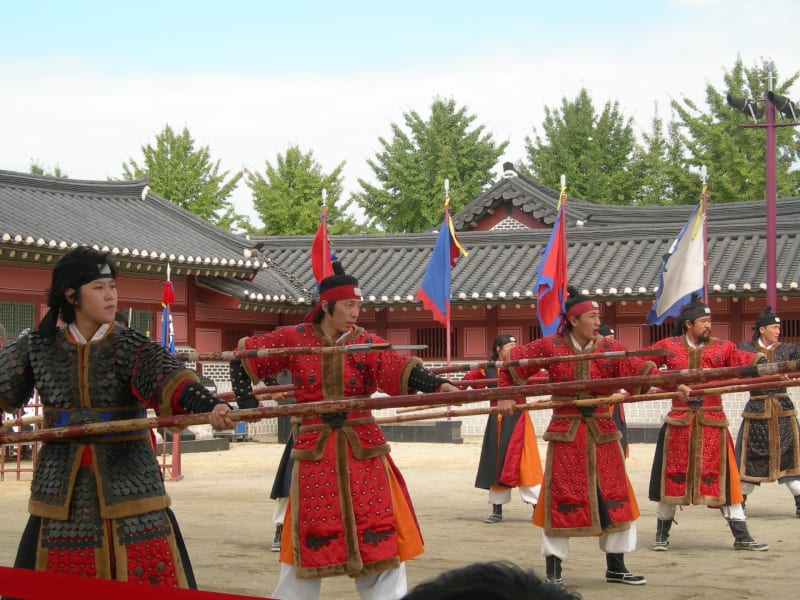
Alongside it stands a second, more honest strand: the Muye 24-ki (무예24기), a declared reconstruction from the manual, supported by the city of Suwon and performed several times a week at Hwaseong Haenggung — that is, at the place for whose garrison the book was written. Whoever calls himself a reconstruction is claiming no line.
Common fallacies
“The Muyedobotongji proves a continuous Korean martial tradition.” It proves that twenty-four methods were taught in 1790. About the time before it says little, and about the time after it nothing — the canon ended with the force it was written for.
“Sibpalgi is Korea’s oldest martial art.” The term is from 1759 and comes from Crown Prince Sado. The art of that name is from 1969.
“The manual is a purely Korean work.” Its great-grandfather is Qi Jiguang’s Jixiao Xinshu of 1561, and its sword chapter carries Japanese methods under Japanese names. The book says so itself.
“1795.” That year stands in several English-language reference works. The UNESCO Memory of the World register, which took the work in in 2017 on a nomination by the DPR Korea, gives the printing date as April 1790; Korean scholarship dates completion to the 29th day of the fourth lunar month of Jeongjo’s 14th year — 1790 as well.
“The bow is missing because it did not matter.” It is missing because it was the core subject of the military examination. Exactly the other way round.
Related Articles
- Subak — where this manual’s gwonbeop chapter is cited as evidence, and where it is explained why that does not hold
- Taekkyeon — the opposite case: no book, but a transmitter known by name down to 1987
- Haidong Gumdo — the same gap between source and present, only with an invented source instead of a real one
- Gungsul — the core subject of the military examination, and therefore the loudest absence in the canon
- HEMA — the same starting position in Europe, with the gap expressly named
- Taekwondo — the art whose claim to age most often leans on this manual
- Kuk Sool Won — the claim to gather the whole Korean tradition in one system
- Stick Fighting Compared — eight systems, none Korean; gonbong and pyeongon stand in the manual with a plate and a date
- Hwarangdo — the counter-case without a manual: no author, no date, no technique