Mas Oyama — The Strongest Karateka in History
Mas Oyama (1923–1994) knocked down bulls with bare hands and founded Kyokushin — the world's hardest karate with 15 million practitioners.
Contents
Overview
Masutatsu Oyama is a legend of the martial arts — a man whose deeds sound so extraordinary they border on myth, yet are historically well documented. He knocked down 52 bulls with bare hands — three killed outright, 49 with their horns sheared off. He spent 18 months in mountain isolation, using only rocks and trees as training partners. He created Kyokushin (the ultimate truth), the first Karate style to establish full body contact as a core principle. His life’s work revolutionized modern combat sports thinking.
| Birth name | Choi Yeong-eui (崔永宜) |
| Japanese name | Masutatsu Ōyama (大山倍達) |
| Born | July 27, 1923, South Chungcheong, Korea |
| Died | April 26, 1994, Tokyo, Japan |
| Martial art | Kyokushin (founder), Goju-ryu, Shotokan, Boxing, Judo |
| Teachers | Gichin Funakoshi (Shotokan), So Nei Chu (Goju-ryu) |
| Notable students | Bobby Lowe, Jon Bluming, Howard Collins, Shokei Matsui |
Early Life and Training
Oyama was born in Korea — as Choi Yeong-eui — and was sent at age 9 to his sister’s farm in Manchuria, where a Chinese farmworker taught him his first Kung Fu fundamentals. In 1938 he followed his brother to Japan, trained in Judo and Boxing, and eventually began studying Shotokan under Gichin Funakoshi.
The decisive influence came from So Nei Chu, a Goju-ryu master who understood Oyama’s Korean identity and hunger for intensity. Oyama earned his 4th Dan in Shotokan and 7th Dan in Goju-ryu.
Turning Points
After World War II — unsettled and directionless — Oyama decided to dedicate everything to training. He retreated to Mount Minobu (the same mountain where Miyamoto Musashi is said to have developed his style) and trained in complete isolation for 18 months: daily techniques against rocks, trees, and waterfalls.
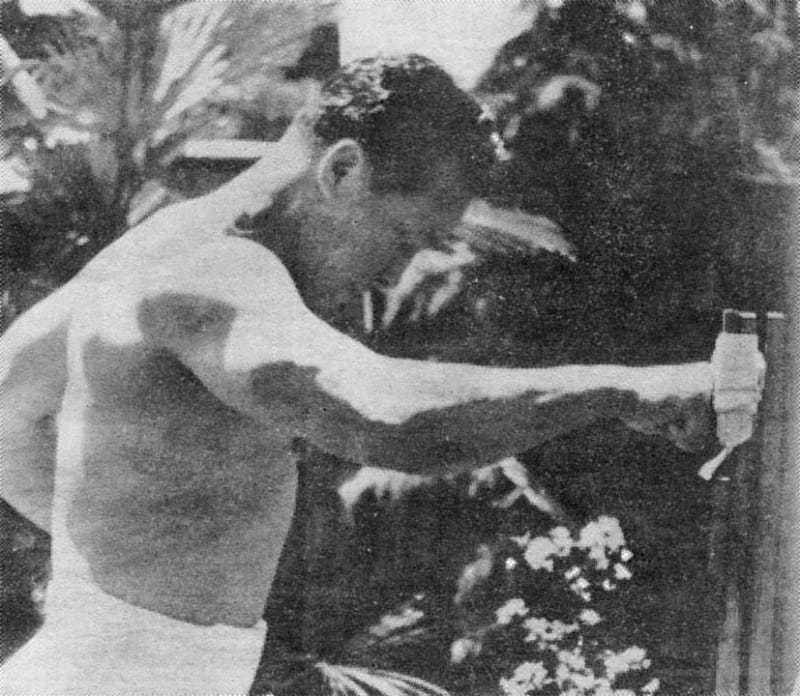
In 1950 he began his bull-fighting demonstrations. Over years of intense public appearances, he defeated 52 bulls — a spectacle that brought him worldwide fame and established Kyokushin as the world’s hardest Karate.
In 1964 he formalized Kyokushin under the name Japan Karate-Do Kyokushinkai and built a worldwide network active in over 120 countries by 1994.
Techniques and Principles
Kyokushin is known for its extreme physical demands:
| Feature | Description |
|---|---|
| Full contact | Unrestricted body contact without protective equipment |
| Tameshiwari | Breaking of materials (wood, stone, ice) |
| Deep breathing | Breath training and kime (power focus) |
| 100-man Kumite | Extreme training: 100 consecutive bouts |
| No face punches | Competition rule — allows hard sparring safely |
| Osu | Greeting and expression of readiness to endure |
Philosophy
Oyama’s philosophy was direct and unadorned: “Martial art means suffering.” He believed true strength — physical and mental — grows only through consistent endurance of pain and exhaustion.
He was influenced by the samurai ideal of Bushido and by Miyamoto Musashi’s Go Rin No Sho, which he claimed to have read a hundred times. His major work “This is Karate” (1965) is a mixture of technical manual and life philosophy.
Kyokushin’s motto: Osu no Seishin (The Spirit of Perseverance) — Osu is both greeting and creed.
Students and Legacy
- Shokei Matsui — Successor as Kancho (Director) of the IKO
- Jon Bluming — Brought Kyokushin to Europe
- Bobby Lowe — Canada’s first black belt in Kyokushin
- Semmy Schilt — Later K-1 World Champion
After Oyama’s death the Kyokushin organization fragmented — today there are multiple competing organizations.
Connections to Other Arts
Oyama studied Shotokan under Funakoshi and Goju-ryu under So Nei Chu — both flow into Kyokushin. His full-contact approach directly inspired K-1 Kickboxing, Muay Thai hybrids, and many MMA fighters. Knockdown Karate as a category was created by Kyokushin.
Today
Kyokushin has over 15 million practitioners worldwide. The 100-man Kumite remains a mythical ideal — fewer than 20 fighters have officially completed it. Oyama’s legacy lives in K-1, kickboxing, and in every combat sports athlete who understands full contact as the test of truth.