HEMA — the Martial Art That Admits Its Gap
The one major martial art that retrieves itself wholly from texts after a break — and for that very reason the best documented.
Contents
HEMA stands for Historical European Martial Arts — the reconstruction of European fighting systems from their own instructional books. What is practised is above all the longsword, along with sword and buckler, messer, dussack, rapier, wrestling and polearms. The sources run from about 1300 into the seventeenth century; the present movement dates from the 1990s.
Between those two figures lies a gap of some three hundred years, and it is the reason this article belongs in the collection. HEMA is the one major martial art that, after a demonstrable break, retrieves itself wholly from texts. Broken lines are not rare in this collection — at bartitsu in 1903, at pradal serey from 1975 to 1979. The difference is the distance to the source: pradal serey was rebuilt from surviving practitioners, bartitsu from the publications of its own founder — barely a century old, and every one of its components (jūjutsu, boxing, savate, la canne) has been practised without interruption. HEMA retrieves itself from manuscripts up to six hundred years old, and for the longsword there is no living line at all. And HEMA is the only one that states the break openly. There is no unbroken line from Liechtenauer to today’s club, and nobody claims one.
From that follows an observation that touches the whole rest of this collection and that sounds like a mistake on first hearing: an art with an admittedly broken line is better documented in its historical technique than most arts with an asserted unbroken one. The reason is mundane. Anyone who has a line need write nothing down. Anyone without one has only what was written — and here that means dated, named, physically extant manuscripts.
What HEMA is not
Three demarcations, because the confusions are persistent:
- Not sport fencing. Olympic fencing grew out of the same European tradition but developed over centuries into a sport with a ruleset of its own. HEMA goes back to the sources from before that development.
- Not reenactment or LARP. Those are about depiction. HEMA trains against resistance, with protective equipment, and tests whether an interpretation works.
- Not one martial art but many. Between the sword-and-buckler fencing of around 1300 and the seventeenth-century rapier lie different weapons, purposes and countries. “HEMA” names a way of working, not a system.
The sources
The body of Fechtbücher — fight books — is the real subject. The principal reference points:
| Source | Date | Content |
|---|---|---|
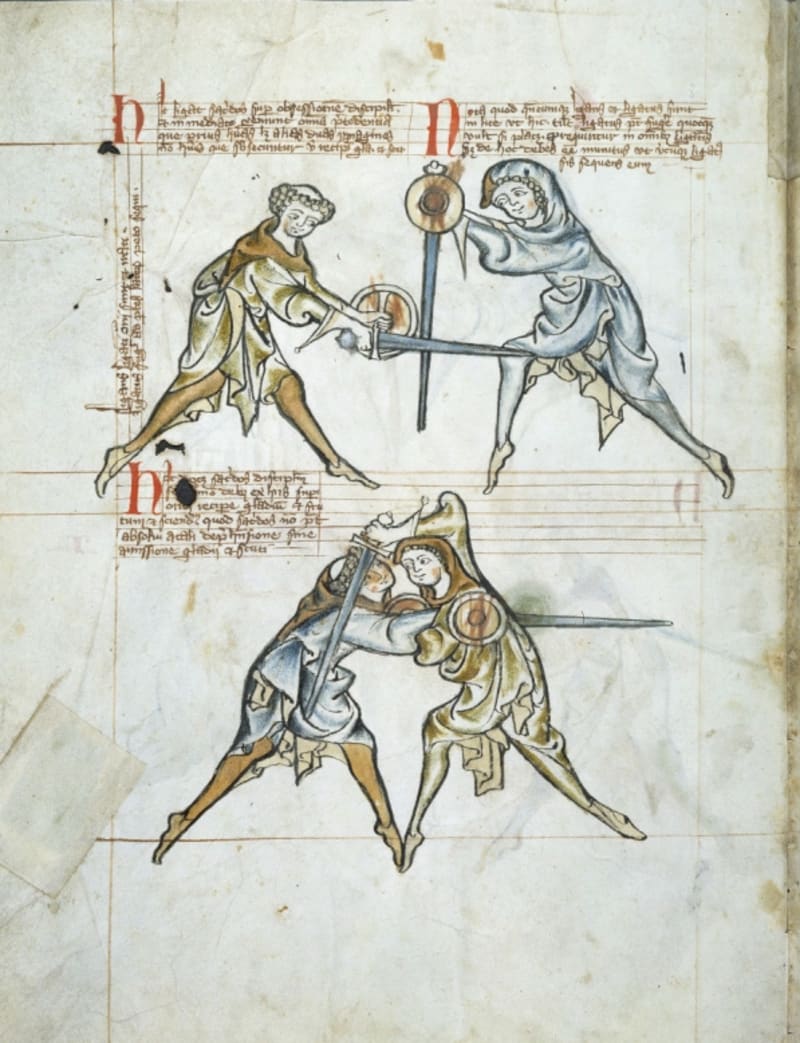
| Royal Armouries MS I.33 | c. 1300 | the oldest surviving fight book of any kind; sword and buckler, built on seven wards (custodie) |
| GNM MS 3227a (Nuremberg) | late 14th c. | the earliest record of Johannes Liechtenauer’s Zettel, the mnemonic verse on the longsword |
| Fiore dei Liberi, Fior di Battaglia / Flos Duellatorum | completed by 1409 | the earliest Italian master with a surviving manual; wrestling, dagger, sword, spear, mounted combat |
| Bolognese school (Manciolino 1531, Marozzo 1536) | 16th c. | printed manuals, a broad range of weapons |
| Joachim Meyer, Gründtliche Beschreibung der Kunst des Fechtens | Strasbourg 1570 | one of the most complete systems of the German tradition |
One point deserves emphasis, because it inverts the picture: not a single manuscript by Liechtenauer himself, the most famous name in the German tradition, is known. What exists are other people’s records, beginning with MS 3227a. His Zettel is moreover deliberately obscure — a mnemonic for initiates, not a set of instructions. The entire German tradition therefore rests on a text that cannot be read without commentary.
What the manuscripts do not say
Here lies the limit, and HEMA generally names it itself — which deserves explicit credit in this encyclopaedia, because it remains the exception.
The fight books transmit wards, cuts, plays and their sequence. They do not transmit: how much pressure to bind with, how fast a tempo is, exactly where the foot goes, how hard the blows landed, what a master added by mouth. A picture shows a position, not the route to it. Every realisation therefore contains inference, and different schools reach different results from the same page.
That is not a defect of the movement but its situation — and how it is handled is the test. A group presenting its interpretation as the interpretation claims more than the source supports. One that says “this is how we read this passage, and here is what would show us we are wrong” is working cleanly. The same criterion underlies this site’s kata and bunkai programme, and that is no coincidence: bunkai in karate is exactly the same task — a transmitted form without a transmitted application.
1487: the earliest dated instance of a familiar pattern
This collection describes the same process in several places: a grown practice takes on the shape its institution requires — qigong in the 1950s, changquan in 1958, the duanwei in 1998, the grading systems from 1883.
Europe supplies the earliest datable instance in the entire collection. The Marxbrüder (Brotherhood of St. Mark), securely attested from 1474, received in 1487 from Emperor Frederick III the monopoly on the title Meister des langen Schwerts — a state-granted exclusive competence to examine and appoint fencing masters. They met annually in Frankfurt and elected a captain.
And it went as it had to: in 1570 a second brotherhood, the Federfechter, arose in Prague, recognised by Frankfurt in 1575 over the Marxbrüder’s protests — and from 1607 both held equal privileges, Rudolf II having issued the Federfechter their letter of privilege.
That is the same process in the same order four centuries before Kanō’s dan grades: an authority grants the right to appoint masters; a competitor appears; in the end two bodies coexist with equal standing. Anyone who takes the pattern for an East Asian peculiarity has simply not looked back far enough.
The break — and the rediscovery
Why the line broke is not in dispute: firearms made the sword dispensable as a weapon of war, duelling was hedged in and finally banned, and what remained of fencing became a sport. The books, however, stayed where they were — in libraries, archives and collections.
The rediscovery is unusually well datable and has nothing mystical about it:
- Victorian precursors. Attempts to revive old fencing styles existed as early as the late nineteenth century.
- Patri Pugliese. Over decades he collected fight books, photocopied them and posted them to interested individuals and clubs. Before the internet that was the distribution infrastructure of the whole thing.
- 1992: ARMA is founded and becomes the model for the movement’s club structure.
- From the mid-1990s work proceeds systematically.
- 2009: Wiktenauer, launched by Michael Chidester, gathers the sources and translations in one place.
The remarkable feature: the movement depends on the accessibility of sources, not on teachers. It accelerated when copying became cheap, and again when digitisation arrived. There is hardly a second martial art whose growth curve can be explained so directly by library technology.
The tournament problem, observable live
HEMA now has a competitive scene, and with it a conflict this collection knows from several directions: a ruleset generates technique. That is the argument of the throwing principles comparison; it recurs at kosen judo and at freestyle wrestling.
The difference is that with HEMA it can be watched right now, and that the participants argue about it themselves. Under negotiation are, among others:
- the afterblow: a hit that still lands after one’s own reduces the score — an attempt to bring the risk of the double hit into the rules.
- double hits in general: in the sources striking simultaneously is a mistake; in a tournament it has to be scored somehow.
- right of way, adopted from sport fencing and contested for that reason.
- whether flat strikes should count.
The critics’ objection is precise and not easily dismissed: a tournament rewards what scores, and that need not be what the fight books teach. The other side’s objection is equally precise: without resistance every interpretation stays untested — and then you have calligraphy instead of fencing.
Both are right, and this article does not resolve it. It is exactly the tension that in other martial arts was settled long ago, mostly in favour of competition and without anyone noticing. Here it lies openly on the table, next to the sources against which it can be checked.
Connections to other martial arts
- Kenjutsu — the most instructive comparison. The Japanese sword schools have what HEMA lacks: a line from teacher to student. They have less of what HEMA has: a dated text against which one can check whether today’s execution matches the old one. Two routes to the same question, with opposite strengths.
- Kendō — the opposite pole: what becomes of a sword art when a competition ruleset takes it over completely. HEMA stands at that fork today.
- Iaidō — the other answer: form without an opponent, with all the merits and all the doubts that entails.
- Canne de combat — the European neighbour that solved it differently: it became a sport and thereby kept its continuity.
- Grading systems compared — the Marxbrüder of 1487 are the earliest evidence for its argument, and they are found in Europe, not Japan.
- Kata and bunkai — the same task in another language: a transmitted form, an untransmitted application, and the question of how to test an interpretation.
Today
HEMA is one of the fastest-growing martial arts movements in Europe and North America, carried by clubs, open tournaments and an unusually text-friendly community. Entry requires protective gear — mask, gloves, jacket — and that is the main hurdle: it costs considerably more than a gi.
Two questions help in placing a club. First: which source is being worked from? A serious group can name it — Liechtenauer tradition, Fiore, Meyer, the Bolognese school — and say which translation it uses. Where the answer is “medieval swordfighting” with no text, it is not HEMA. Second: is a distinction drawn between source and interpretation? “That is what the book says” and “that is how we understand it” are two different sentences, and good instructors use both.
The value of this art in the end does not lie in the sword. It lies in a community publicly demonstrating how a martial art is built from sources rather than by appeal to a lineage — with all the uncertainties left visible. For an encyclopaedia that has had to point out the same gap between narrative and evidence at Wudang, Subak, Haidong Gumdo and Pangai-noon, this is the most comfortable article of the series: here the gap was admitted before anyone had to ask.
Related articles
- Kenjutsu
- Kendō
- Iaidō
- Canne de Combat
- Grading Systems Compared
- Kata and Bunkai — a Programme
- Bartitsu — the same situation taken one step further: there the boundary is named canonical versus neo
- Sport Fencing — the same root, the opposite route — the line that did not break
- Jōdō — the counter-case: here the line is continuous and the texts are secondary
- Sibpalgi — the same starting position in Korea, with an appendix tabulating the divergences
- Jogo do Pau — the same revival, but out of living witnesses instead of manuscripts