Wudang — a Mountain Range, a Category and a Text From 1669
Wudang is not a style but a mountain range and a category. The split into internal and external martial arts can be dated to a single year: 1669.
Contents
“Wudang” (武當) is a word that carries an air of great precision in the martial arts world — one reads it as the counterpart to Shaolin, as the home of the internal styles, as the origin of taijiquan. In fact it denotes three things, and only the first is unambiguous:
- A mountain range in Hubei province holding one of China’s most important Daoist temple complexes.
- A category — the “internal” styles, as opposed to the “external” ones of Shaolin.
- A group of modern schools that have taught there since the 1980s.
A single unified style called Wudang does not exist. And the category under point 2 has a surprisingly precise birthday.
History: the place
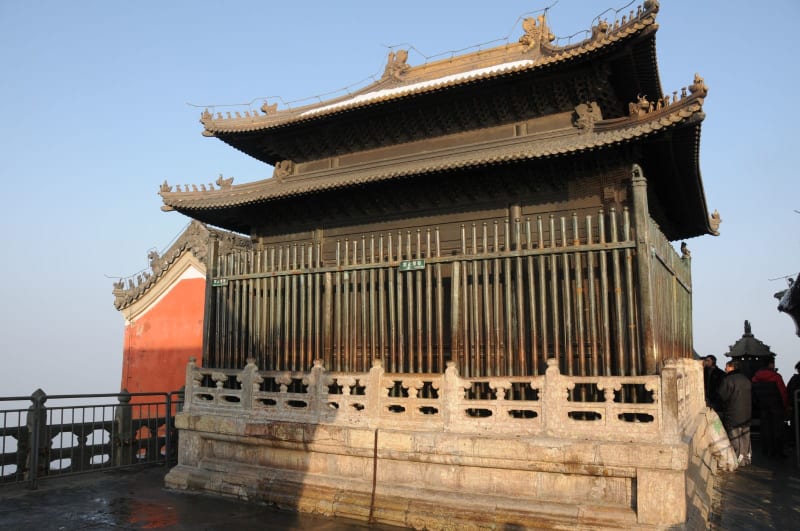
The Wudang Mountains have been a centre of Daoism since the Middle Ages, dedicated to the god Xuanwu. Under the Yongle Emperor an extensive building programme of monasteries, halls and pathways was carried out in the early 15th century, giving the complex the shape it retains today. In 1994 the site was inscribed on the UNESCO World Heritage list.
That physical practice, breath work and health regimens were cultivated at a Daoist centre of this size is not in dispute. The leap from there to a closed martial system is.
The text of 1669
The division into internal (內家) and external (外家) martial arts goes back to a single datable source: the Epitaph for Wang Zhengnan, written in 1669 by the scholar Huang Zongxi (1610–1695).
In it Huang describes two schools. He assigns the external one to Shaolin: its movements attack and thereby give the opponent a target. The internal one, he says, overcomes movement with stillness and repels the attacker easily. Its origin he traces to Zhang Sanfeng, a Daoist alchemist of Mount Wudang.
That is the first known text to claim any of this. Everything said today about internal styles, Wudang and Zhang Sanfeng as a martial founder hangs on this epitaph or on its reception.
And it is not a neutral technical text. Huang Zongxi wrote as a loyalist of the fallen Ming dynasty under the new Manchu Qing rule. In his account the internal is Daoist and therefore Chinese, the external Buddhist and therefore foreign in origin. Much of sinology therefore reads the distinction not as a technical classification but as a political statement in martial-arts dress — a declaration of loyalty to a vanished dynasty.
That says nothing about the quality of internal training methods. It does say something about where their classification came from: not from observing fights, but from an obituary with a political subtext.
What “Wudang martial arts” denotes today
| Usage | What is meant | How solid |
|---|---|---|
| The place | temple complex in Hubei, World Heritage since 1994 | secure |
| The category | collective term for the internal styles | attested from 1669, politically shaped |
| Zhang Sanfeng as founder | attribution of taijiquan | legend, first attested 1669 |
| Today’s schools | teaching at the mountain since the 1980s | secure, but recent |
Three systems are usually counted as “internal”: taijiquan, xingyiquan and baguazhang; liuhebafa is often added as a fourth. None of these systems originated at Wudang — they are assigned to it.
What today’s Wudang schools teach
What is taught at the schools on the mountain can be described well, even if its history is short:
- Forms performed with markedly slow, flowing execution
- Wudang sword (武當劍) — the best-known weapon discipline, with wide, circling blade paths
- Qigong and breath work, often in Daoist terminology
- Meditation and health exercises, closely tied to the life of the temple
- Walking stance changes, related to baguazhang
The connection to the place is real: teaching takes place within a Daoist framework, with its daily rhythm and vocabulary. That framework, however, is a resumption of a tradition after the Cultural Revolution rather than its unbroken continuation.
Connections to other martial arts
- Taijiquan — the most prominent system credited with a Wudang origin; the documented lineage instead leads to the village of Chenjiagou
- Xingyiquan and baguazhang — the other two systems in the trio
- Liuhebafa — the frequently named fourth internal style, with a comparable evidential position
- Ki, Chi and Prana — the conceptual apparatus the internal styles work with
- Kung Fu / Wushu — where all of this sits
Today
Wudang is now a major destination for martial arts travellers. Since the 1980s numerous schools have grown up on the mountain, some offering training of several months for foreign students; tourism and instruction are closely intertwined.
That is not a reproach. The practice is serious, many teachers are excellent, and in few places is the union of martial art and Daoist practice so directly experienced. One should simply know when booking that this is a revival rather than an unbroken transmission — and that the contrast “hard like Shaolin, soft like Wudang” originates in an epitaph from 1669 and not in a comparison of two fighting styles.
Related Articles
- Taijiquan
- Xingyiquan
- Baguazhang
- Liuhebafa
- Kung Fu / Wushu
- Ki, Chi and Prana
- Shaolin Kung Fu — the same position: unbroken institution, broken martial practice
- Qigong — what is taught there within the monastic frame — and where the name comes from