Ankō Itosu — the Man Who Put Karate into Schools
Itosu brought karate into Okinawa's schools in 1901 — and justified it to the ministries in 1908 by its usefulness for military service.
Contents
Overview
Itosu Ankō (糸洲安恒, 1831–1915) founded no school, named no style after himself and left behind no duel that anyone recounts. He therefore appears in no list of founders — and is nevertheless the most consequential single figure in the history of karate.
What he did was an administrative decision: he brought karate into Okinawa’s school lessons from 1901. Everything that followed — the spread to Japan, mass instruction, standardisation, the competitive sport — presupposes that step. Without it karate would probably have remained what it had been: a handful of family lineages in and around Shuri.
The price of that step is equally consequential and told less often. What was to fit into a classroom had to be simplified — and part of what fell away is still missing from karate today.
Youth and training
Itosu was born in 1831 in Gibo, Shuri, into a family of the keimochi — the lower Ryūkyūan nobility, the pechin. He grew up in a strict household, was educated in the Chinese classics and in calligraphy, and was considered small, shy and withdrawn.
His first training came from Nagahama Chikudun Pechin of Naha. At about the age of thirty he became a student of Matsumura Sōkon, the formative master of Shuri-te and bodyguard to the Ryūkyūan kings.
And here lies the biographical break that explains everything after it: Itosu served as secretary to the last king of the Ryūkyū Kingdom — until Japan abolished the monarchy in 1879 and made Okinawa a prefecture. With the kingdom vanished the class the martial art had existed for. A man whose office and whose art lost their basis at the same moment went looking for a new one for both.
The answer he found was the school.
Key moments
| Year | Event |
|---|---|
| 1879 | Dissolution of the Ryūkyū Kingdom; Itosu loses his post as secretary |
| 1901 | Karate enters physical education in Okinawa’s public schools |
| ~1905 | Itosu teaches tōde at Okinawa’s First Junior Prefectural High School and develops there the systematic teaching method still in use |
| ~1905 | The pinan kata are created — as learning steps for schoolchildren |
| October 1908 | The Ten Precepts of Tōde (Tōde Jūkun), a letter to the Ministry of Education and the Ministry of War |
| 11 March 1915 | Death in Shuri, aged 83 |
The pinan kata — and what they reveal about their audience
The five pinan forms (Japanese heian) are Itosu’s best-known legacy. They did not arise as advanced material but from a teaching problem: the inherited kata were too difficult for schoolchildren.
He drew on older and longer forms as his source, traditionally given as kūsankū and chiang nan. From that material he shaped five short, cumulative exercises.
That is a curriculum decision, not a development in martial art — and it should be read as one. The pinan are not the essence of Shuri-te; they are a staircase somebody built so that twelve-year-olds could get up it.
The Ten Precepts of 1908 — and the sentence rarely quoted
In October 1908 Itosu wrote to the Japanese Ministry of Education and Ministry of War, seeking to bring karate into school teaching beyond Okinawa. The text is written in a very old literary style and is considered hard to translate; it is nevertheless the most important document of early karate history.
The first precept states what karate is not for:
Karate is not merely practised for your own benefit; it can be used to protect one’s family or master. It is not intended to be used against a single assailant.
The second precept states what, in his view, it very much is for — and this sentence contradicts the common account so plainly that it is seldom quoted alongside:
The purpose of karate is to make the muscles and bones hard as rock and to use the hands and legs as spears. If children were to begin training naturally in military prowess while in elementary school, then they would be well suited for military service.
That is not an aside but the selling point of the whole letter. Itosu is petitioning a ministry of war, and he petitions with what a ministry of war cares about.
What that means for the image of the “peaceful way”
The idea that the schooling of the East Asian martial arts was a turn towards the pedagogical and the peaceful does not survive this document. The comparison of dō and jutsu shows the same thing in the dates: the wave of renamings falls not into a peace movement but into the decades of rising nationalism.
Itosu’s 1908 letter sits exactly between — eleven years before kyūdō was renamed, twenty-eight years before karate itself was. It shows the mechanism in miniature: anyone wanting to bring a martial art into state institutions had to justify it in their language.
What is not being said: that Itosu was a militarist. The document records what he argued with, not what he thought. A petitioner writes what the addressee wants to hear — and Itosu was a petitioner.
What school teaching cost
Here this article leaves what is documented and enters what is interpreted; that should be said.
Documented: the kata were simplified for schoolchildren, and a form of instruction for large groups without partners came into being.
Interpreted: with that the applications largely fell away. The comparison of fist, hikite and the boxing guard shows it in a single well-documented case: the hikite — the withdrawing hand — grips the opponent in the early sources. In the schooled form it returns empty to the hip. The movement remained, its object disappeared.
Mass instruction needs techniques that can be practised without a partner. What needs a partner — gripping, throwing, levering — cannot be taught to a class of forty children. It did not vanish because anyone thought it wrong, but because it did not fit the room.
And the sharpest criticism of it came from his own circle of students: Motobu Chōki, who studied under Itosu, became the best-known critic of the schooled form of his generation.
Students and legacy
The list of his students is the real evidence of his importance. Nearly every major karate lineage of the twentieth century runs through him:
| Student | What came of it |
|---|---|
| Gichin Funakoshi | took karate to Japan in 1922; Shōtōkan grew from his line |
| Kenwa Mabuni | founder of Shitō-ryū — the ito in the style name is Itosu |
| Chōshin Chibana | thirteen years under Itosu; keeper of Shōrin-ryū |
| Motobu Chōki | the best-known practitioner of his generation — and critic of the school form |
| Motobu Chōyū | elder brother, line of Motobu Udundī |
| Kentsū Yabu, Chōmo Hanashiro | the first karate teachers in the school service |
| Kanken Tōyama, Shinpan Shiroma, Moden Yabiku, Anbun Tokuda | further lines, some reaching into kobudō |
That the style name Shitō-ryū is half made of his own is the clearest indication of his standing: Mabuni formed it from the first characters of his two principal teachers — Itosu and Higashionna.
Connections to other martial arts
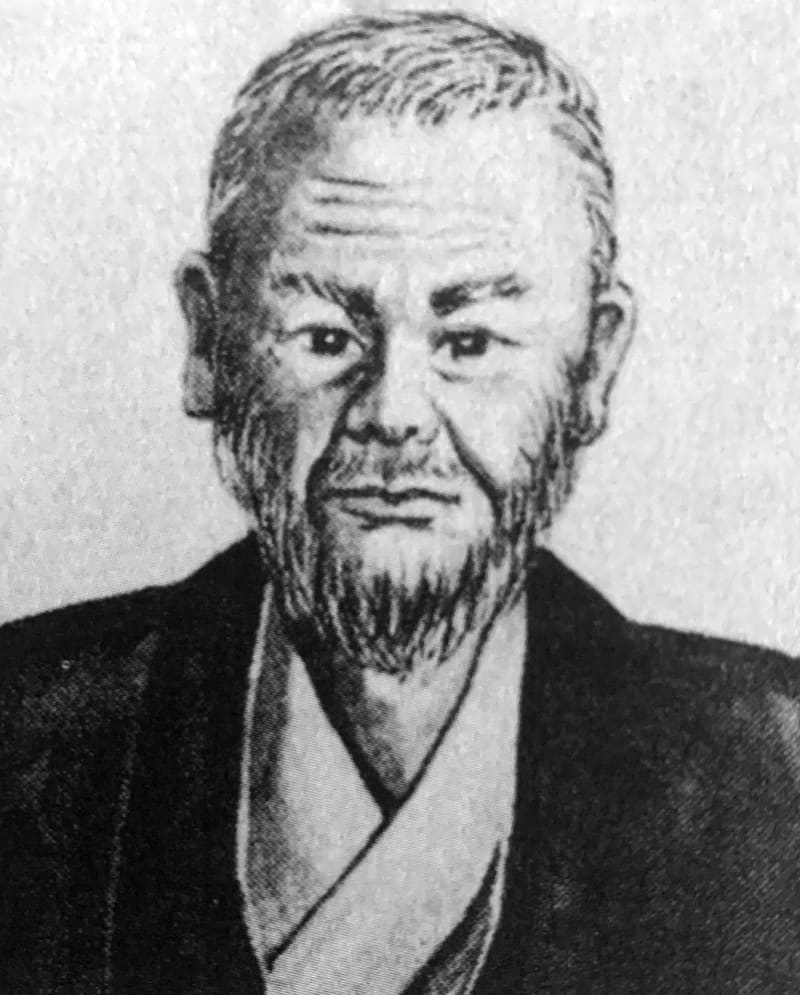
- Okinawan karate — the stock names him there as the man who institutionalised the subject; the portrait on this page is the same image
- Karate — the break around 1900 is his work
- Shōrin-ryū — the line he took from Matsumura and passed on
- Shitō-ryū and Shōtōkan — two of the four great Japanese styles descend directly from his students
Today
Itosu is usually called the “grandfather of modern karate”, and the phrase fits if one does not read it as praise. He is the grandfather in the sense that everything later had to pass through him — including what karate lost on the way.
The pinan kata are practised worldwide in almost every karate lineage, mostly without anyone knowing they were made for schoolchildren. And the criticism levelled for a hundred years at the empty form of movement is, in substance, aimed at a decision taken in 1901 — a decision without which the critics would not exist, because the karate they practise would not.
Related Articles
- Okinawan karate — the art he turned into a school subject
- Karate — the overview in which his break around 1900 is recorded
- Shōrin-ryū — the line from Matsumura through Itosu to Chibana
- Shitō-ryū — the style whose name is half his own
- Shōtōkan — the line of his student Funakoshi
- Gichin Funakoshi — the student who took karate to Japan in 1922
- Fist, Hikite and the Boxing Guard Compared — what schooling cost the hikite
- Dō and Jutsu Compared — his 1908 letter shows in miniature the mechanism that comparison finds in the dates
- Kenwa Mabuni — his student, who spent forty years doing the opposite and discarded nothing
- Kanbun Uechi — the same period, the same island, the opposite conclusion from the same observation
- Chōki Motobu — his student — and the sharpest critic of exactly the schooling Itosu carried out
- Matsumura Sōkon — his teacher, bodyguard to the same king whose secretary Itosu was