Chōki Motobu — the Fighter Whose Victory Was Printed with Another Man's Face
In 1922 Motobu knocked out a boxer at the age of 52. When King magazine illustrated the victory in 1925, the drawing showed Funakoshi.
Contents
Overview
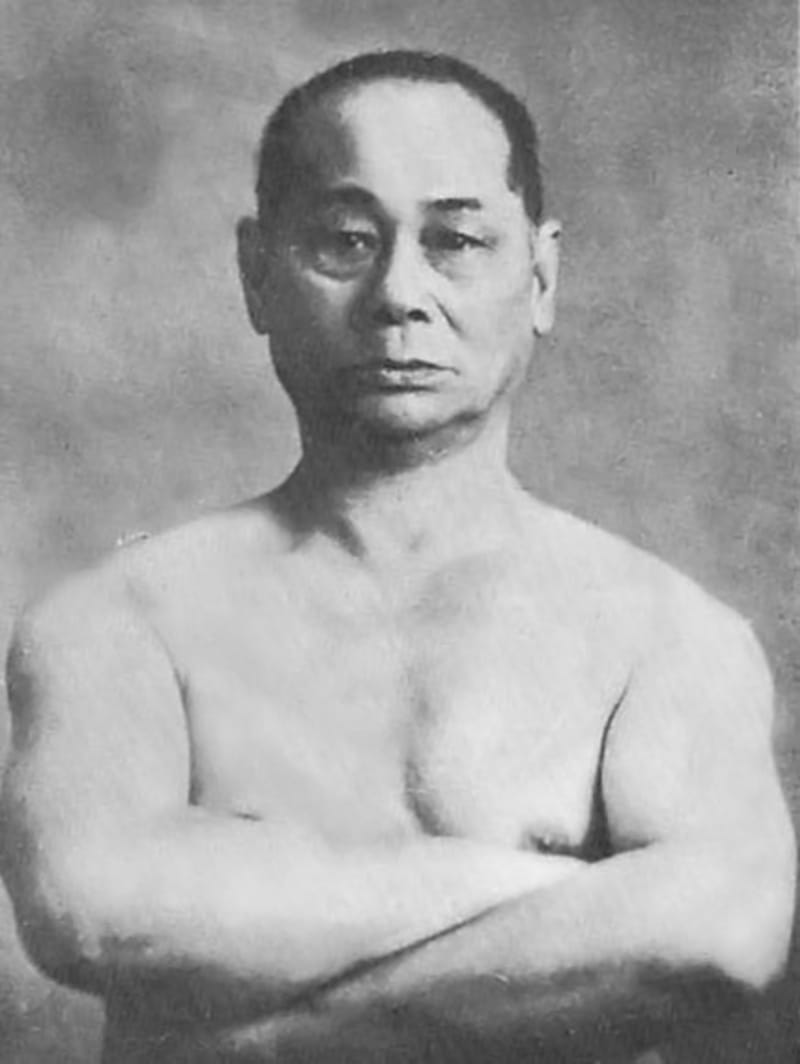
Motobu Chōki (本部朝基, 5 April 1870 – 15 April 1944) was the best-known karate practitioner of his generation, and its most inconvenient.
His role in this encyclopedia’s stock is that of the counter-witness. Where Ankō Itosu brought karate into the schools and Gichin Funakoshi translated it for Japan, Motobu insisted it was there to fight with — and he was the only one of the three who demonstrated that in public.
The story that says everything about his relation to the other two is the story of a printing error.
Origins — and what he did not inherit
Motobu was the third son of Prince Motobu Chōshin. The family belonged to the Motobu Udun, a cadet branch of the Ryūkyūan royal house.
And that is the starting point. The family art of the Motobu Udun — Motobu Udundī — was according to tradition passed within the line of the eldest son and went to his elder brother Chōyū. As third son Chōki stood outside it and had to assemble his karate elsewhere.
What he assembled is an unusual list:
| Teacher | Line |
|---|---|
| Ankō Itosu | Shuri-te |
| Matsumura Sōkon | Shuri-te |
| Matsumora Kōsaku | Tomari-te |
| Sakuma | — |
For his agility he carried the nickname Motobu no Saru, “Motobu the Monkey”.
November 1922, Kyoto
Motobu moved to Osaka in 1921. In November 1922 he took part in an event in Kyoto pitting judo against boxing, and knocked out a foreign boxer.
He was fifty-two years old.
Who the opponent was is still not settled; sources call him “George” or “John”, and research has proposed the Estonian boxer Jaan Kentel.
What that fight meant is hard to overstate. On the Japanese mainland karate was at that point a novelty from a recently annexed prefecture. An Okinawan knocking out a Western boxer was the proof the thing needed — and Motobu supplied it physically, not in writing.
The printing error
In 1925 the mass-circulation magazine King ran an article about that victory.
The illustration shows Gichin Funakoshi.
Not Motobu. The man who had won the fight got the report; the man who taught karate in Tokyo and wrote books got the face.
That is not an anecdote but the whole era in miniature. In the years when karate established itself on the mainland, what decided things was not who could fight but who could explain — who had contacts in education ministries, who published books, who struck the educated tone. Motobu had none of that, and the drawing in King is the evidence for it in a single image.
And a rumour that belongs to it and is false
It was long said of Motobu that he was illiterate — which suited the contrast with the schoolteacher Funakoshi and was gladly repeated.
It is not true. Surviving samples of Motobu’s handwriting show a clear, literate hand. The rumour is thereby largely discredited — and it is a good example of how a division of roles, once printed, gets shored up biographically after the fact.
The answer: the oldest book on kumite
One year after the King article, in 1926, Motobu published Okinawa Kenpō Karate-jutsu Kumite-hen — the oldest book on kumite.
The timing speaks for itself. The man whose face had been printed away wrote a book — and about precisely the part missing from schooled karate.
What the argument was about
Motobu and Funakoshi were at odds over how karate ought to be taught and what it was for. Motobu’s position can be pinned to two points, and both are technical rather than ideological.
First the kata. He concentrated almost exclusively on naihanchi and held it to be the key to close-quarters combat. A narrow canon, practised deeply — the counter-position both to Kenwa Mabuni’s collecting and to Itosu’s simplifying.
Second the movement itself:
Blocking with one hand and then countering with the other is not true bujutsu.
That is not an aphorism but a claim about simultaneity: defence and counter should be one movement, not two.
And from it follows his best-known objection, which appears at several points in the stock: on the hikite — the withdrawing hand — Motobu criticised not the principle but the height. The fist belongs under the armpit, not at the hip.
The comparison of fist, hikite and the boxing guard records why that is a statement about grip mechanics and not about power generation: a hand under the armpit pulls along a different line than one at the hip. The hand position programme turns that into a testable stage — whoever pulls must force the partner to step, and which of the two heights achieves that is settled by the attempt.
Motobu-ryū
Motobu founded Motobu-ryū. The line survives but has stayed small — which fits: a style resting on few kata and much partner work is hard to teach in bulk. That was exactly the objection.
Today
Motobu’s standing has shifted, in step with the growing criticism of application-free kata karate. Anyone searching today for the lost applications — for what the comparison of kata and kumite argues over — regularly ends up with him.
The irony is considerable: Motobu was a student of the same Itosu whose school teaching pushed the applications out of karate. The sharpest criticism of the schooling came from the circle of students of the man who carried it out.
Related Articles
- Ankō Itosu — his teacher, and the author of exactly the development he criticised
- Gichin Funakoshi — the rival whose face illustrated his victory in 1925
- Kenwa Mabuni — the same teacher Itosu, the opposite answer: collecting instead of deepening
- Kata versus Kumite — the dispute in which he marks the historical counter-position
- Fist, Hikite and the Boxing Guard Compared — where his objection about the height of the hikite is recorded
- Hand Position Programme — makes that objection testable at Stage 2
- Okinawan karate — the context he came from
- Karate — the overview of the development he stood against
- Shōrin-ryū — the Shuri-te line of Itosu and Matsumura, from which he drew part of his karate
- Matsumura Sōkon — his teacher from the Shuri line, alongside Itosu and Matsumora