Edith Garrud — a Martial Art as the Answer to a Law
In 1913 a law made suffragettes re-arrestable after a hunger strike. The answer was a thirty-strong bodyguard — trained by her.
Contents
Overview
Edith Margaret Garrud, née Williams (1872–1971), was the first British woman to teach jūjutsu and one of the first female martial arts instructors in the Western world at all. She stood barely five feet tall and taught women at a time when both facts ran against expectation.
She is in this encyclopaedia for a reason no other article here offers. This is the only documented case in the whole collection in which a martial art was organised as the answer to a specific law. Not as philosophy, not as sport, not as tradition: as a named countermeasure to a named piece of legislation, with a date, a headcount and an equipment list.
The rest of the collection describes arts shaped by rulesets — from the throwing principles comparison to sport fencing. Here, for once, it is criminal law that does the shaping.
| Born | 1872 (as Edith Margaret Williams) |
| Died | 1971, aged 99 |
| Art | Jūjutsu |
| Teachers | Sadakazu Uyenishi, Yukio Tani |
| Known for | training the WSPU’s Bodyguard |
| Dojo | Golden Square, London (from 1908) |
How she came to jūjutsu
The route runs straight through the Bartitsu Club. In 1899 Garrud began training, together with her husband William, under Sadakazu Uyenishi and Yukio Tani — the two Japanese teachers Edward Barton-Wright had brought to London through his correspondence with Kanō Jigorō.
Barton-Wright’s club closed in 1903. Uyenishi then taught at his own dojo in Golden Square, and when he returned to Japan in 1908 the Garruds took the school over. The chain is thus complete and unusually short: from an engineer’s failed mixed-fighting venture, via two Japanese employees, to an English instructor — in nine years.
She first became visible outside the dojo. In 1907 she played the lead in the short Gaumont film The Lady Athlete; or, Jiu-Jitsu Downs the Footpads, directed by Alf Collins. On 23 July 1910 Health & Strength published her scenario “Damsel v. Desperado” — a small woman in an empty street disposing of two assailants with blocks, holds and throws.
1913: the law and the answer
In 1908 she first offered classes exclusively to WSPU members. In 1909 she demonstrated jūjutsu at the organisation’s “Women’s Exhibition” and then established a twice-weekly self-defence class, advertised in the union’s paper Votes for Women.
Then came the episode that carries this article. In 1913 the British government passed the act that became known as the Cat and Mouse Act: suffragettes on hunger strike could be released from prison to recover — and afterwards re-arrested on the original charge. Release was not a pardon but a postponement.
The WSPU’s answer was a thirty-strong, all-female protection unit, known simply as the Bodyguard. Garrud trained it. Three particulars are on record, and they describe the undertaking better than any narrative:
- Instruction took place at changing secret locations across London, to avoid the police.
- Besides jūjutsu she taught the use of wooden Indian clubs — concealed in the women’s dresses, as an answer to the truncheon.
- The purpose was extraction, not victory: the task was to keep a particular person out of custody.
What stands there is a curriculum derived from a legal situation. Anyone wanting to know how strongly external conditions shape a martial art has here the shortest route from cause to technique in the whole collection: law → re-arrest → protection of a person → concealed club against truncheon.
What the cartoon shows — and what it does not
The story is almost always told with a single image: Arthur Wallis Mills’s 1910 cartoon “The Suffragette that Knew Jiu-Jitsu”. It shows one woman who has distributed a dozen policemen across a street while others keep their distance.
That image needs handling with care as evidence, and the distinction matters enough for its own paragraph. It evidences the effect, not the technique. That a magazine printed such a drawing in 1910 shows that the jiujitsuffragettes were a public phenomenon — a real and usable statement. What the Bodyguard did, it does not show. They did not throw squads of police across pavements; they trained in secret, worked with diversion and concealed weapons, and succeeded when somebody was no longer there.
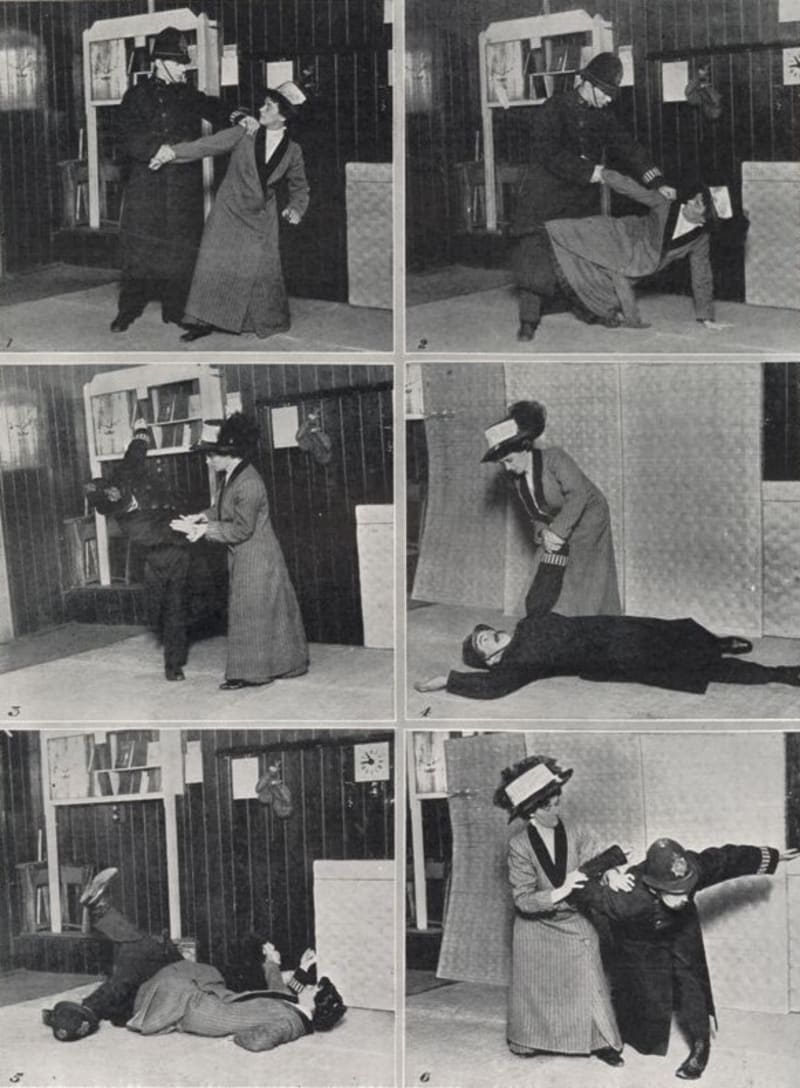
The collection uses the same cartoon in the Bartitsu article, but expressly as evidence of the line of influence from Barton-Wright’s teachers into the women’s movement. For the question of how they actually fought it is useless — for that there are the instructional photo sequences, one of which supplies this article’s image.
The word dates from 2015
A small but characteristic point of source criticism. The now-familiar term “suffrajitsu” is not period: it was coined in 2015 by Tony Wolf for his comic trilogy Suffrajitsu: Mrs. Pankhurst’s Amazons — by the same author who from 2002 drove the rediscovery of Bartitsu.
The contemporary press had its own word, and it was meant less kindly: “jiujitsuffragettes”. Using the more modern term is not using a wrong one — merely one a hundred years younger than the thing. In a collection that had to draw the same distinction at shoshin and shu-ha-ri, it belongs here too.
What is established and what is not
Established: the teaching chain (Uyenishi, Tani, the dojo taken over in 1908), the 1907 film, the scenario in Health & Strength of 23 July 1910, the classes for WSPU members from 1908–09, the 1913 act, the existence and approximate strength of the Bodyguard, its training by Garrud, and the use of concealed clubs.
Less established: the details of individual confrontations. Accounts circulate about the Bodyguard whose tone resembles the cartoon’s, and they are harder to substantiate than the frame. This article therefore does not list them. The finding is strong enough without them — an organisation set up a protection unit because a law made one necessary, and had it trained by a martial arts instructor. That stands.
Connections to other martial arts
- Bartitsu — the origin of her training, and the evidence for its argument: it was not the synthesis that survived but the teachers. Garrud is their furthest-reaching effect.
- Jūjutsu — her art, in the early twentieth-century British version taught by Tani and Uyenishi.
- Judo — the institutional neighbour; London’s Japanese teachers came out of the same milieu, and the paths separated only later.
- Keiko Fukuda — the other woman in this category, and the contrasting case: Fukuda spent decades fighting for recognition inside an institution, Garrud worked from the start against one.
- Budō — the question this article leaves open: whether a martial art that becomes a political instrument is closer to that claim or further from it.
Today
Garrud died in 1971 aged 99; a plaque in Islington commemorates her, and since the 2010s her name appears regularly in exhibitions and books on the women’s movement. That is late fame — for most of the twentieth century she was forgotten.
Two notes for placing her. First: she was not a fighter but a teacher. Her significance lies not in personal combats but in having given an organisation a training programme. Second: the case does not work as advertising for self-defence in general. It is narrow, well documented and tied to a particular situation — thirty women, one law, one purpose. That narrowness is exactly what makes it solid.
What makes it so unusual within this encyclopaedia is the direction. Almost every article here describes how an institution shapes a martial art — federations, examination rules, rulesets. With Edith Garrud, for once, a martial art shaped back.
Related articles
- Bartitsu
- Jūjutsu
- Judo
- Keiko Fukuda
- Budō
- Rusty Kanokogi — the third case of the triad — here the institution was forced to change