Kenwa Mabuni — the Archivist of Karate
Mabuni studied under at least six masters and discarded nothing. His style carries the widest kata canon of any major school — and the names of his two teachers.
Contents
Overview
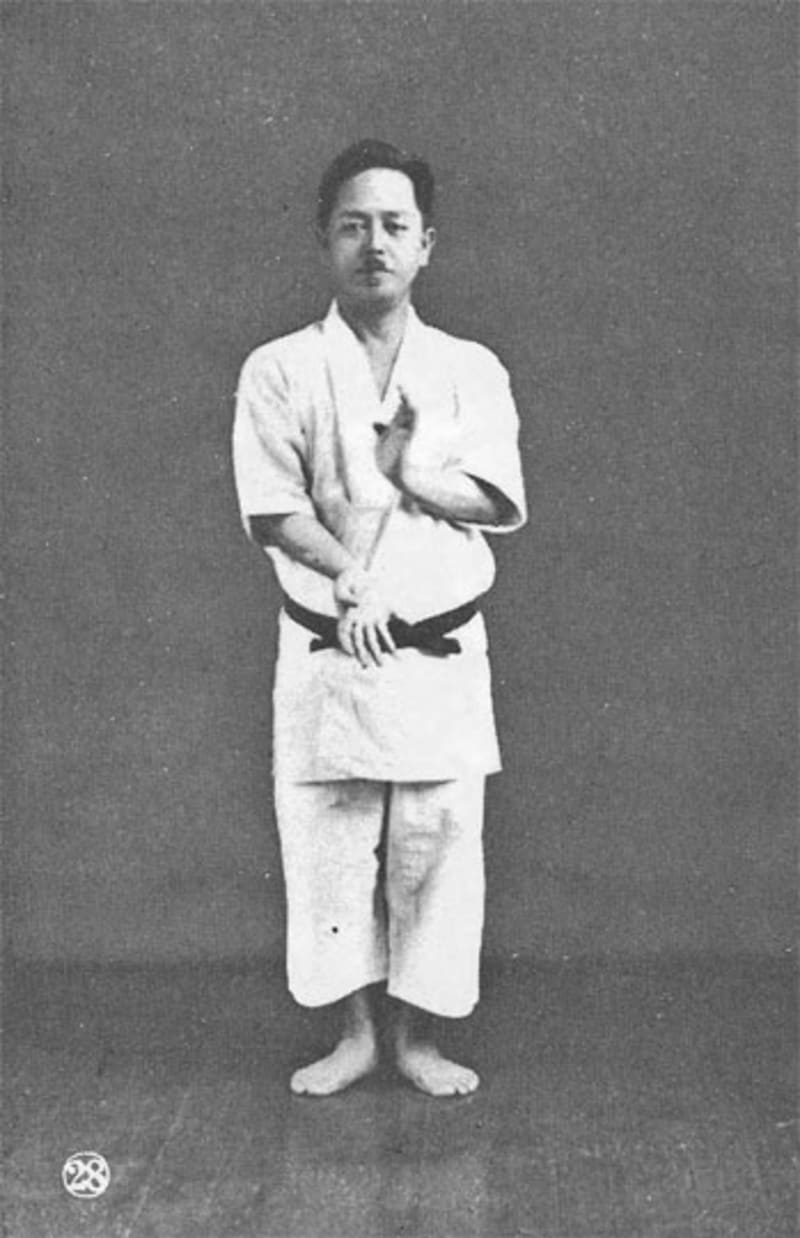
Mabuni Kenwa (摩文仁賢和, 14 November 1889 – 23 May 1952) founded Shitō-ryū, one of the four great Japanese karate styles. Better known than the style, though, is what sets it apart from the others: it carries the widest kata canon of any major school.
That is neither accident nor quirk but Mabuni’s life’s work in a sentence. He studied under at least six named masters — more than any other karate founder of his generation — and he discarded nothing.
And there lies the point of his biography: his first teacher was Ankō Itosu, whose historical achievement lay in leaving things out — he shortened the kata for schoolchildren and created the pinan forms. Mabuni, his student, spent forty years doing the opposite.
Origins and training
Mabuni was born in 1889 in Shuri, Okinawa’s old royal capital, and traced his family to the warrior Uni Ufugusuku Kenyū — in the seventeenth generation.
At the age of thirteen he became a student of Itosu Ankō and learned Shuri-te from him. Tradition holds that Itosu taught him some 23 kata.
In 1909, aged twenty, he additionally began studying under Higaonna Kanryō in Naha — the master of Naha-te who had returned from Fujian in southern China. That training lasted until Higaonna’s death in 1915.
Mabuni thus learned both great Okinawan lineages at once — unusual in his day. Shuri-te and Naha-te were different milieus: the school of the royal court and that of the craftsmen and traders of the port town.
The other four
The two principal teachers stand in the style’s name. Four more do not, and they explain the rest:
| Teacher | What he contributed |
|---|---|
| Aragaki Seishō | Okinawan line with Chinese influence |
| Tawada Shinboku | Shuri-te line |
| Sueyoshi Jino | Okinawan line |
| Wu Xianhui (Jp. Go Kenki) | Chinese master, a tea merchant resident in Okinawa |
The last name is the most revealing. Go Kenki was not a bearer of Okinawan tradition but a Chinese contemporary who happened to live there. Mabuni therefore learned not only what his tradition offered him but also whatever was within reach.
The job that made the collection possible
Mabuni became a police officer. In that capacity he taught law enforcement officers, and at Itosu’s behest he began teaching in primary schools in Shuri and Naha.
That is more than a biographical footnote. Police duty on Okinawa took a man officially through the villages and districts of the island — to exactly where the family lineages sat that nobody had written down. Whoever had access and standing could ask. Mabuni had both.
The obvious explanation for his unusually broad holdings is therefore not special talent but opportunity — and the willingness to use it.
Osaka, and why the style needed a name
In 1929 Mabuni moved permanently to Osaka and became a full-time karate instructor. He opened the Yōshūkan dojo and taught at Kansai University.
In 1934 he named his style: Shitō-ryū (糸東流). The name is an acronym from the on’yomi readings of the first characters of his two principal teachers — Shi for Ito(糸)su and Tō for Higashi(東)onna.
A style name in 1934 was not vanity but a formality. Anyone seeking recognition as a discipline needed a name, a grading order and a curriculum; the comparison of dō and jutsu shows how densely the namings of those years cluster. Mabuni named his style in the same decade in which gōjū-ryū and wadō-ryū were registered.
What is remarkable is what he chose as the name: not himself, not a quality of the art, but his two teachers. The style name is a citation.
The archivist
Contemporary and later accounts alike describe Mabuni as the man with the encyclopaedic knowledge of kata and as the foremost authority on the Okinawan forms. He published several books — at a time when most of it was still passed on by mouth.
What that means in practice shows in the comparison with his contemporaries:
| Contribution | |
|---|---|
| Itosu | reduced — kata for schoolchildren, the pinan forms as a staircase |
| Funakoshi | simplified and translated — karate for a Japanese audience |
| Mabuni | collected and wrote down — what he had learned stayed in the record |
Three students of the same tradition, three opposite answers to the same situation.
And the price of that decision
A broad canon is not straightforwardly an advantage. Shitō-ryū still meets the objection that it has too many kata for one lifetime — that a school preserving everything practises nothing in depth.
The objection is serious and it cannot be settled. It assumes the purpose of a kata is skill. Mabuni’s decision assumes it is the tradition — that a form deserves keeping even when nobody is currently exhausting it.
The kata-bunkai programme states the same attitude as a training rule: the kata is an archive, and an archive may hold entries nobody can currently read. Anyone who thinks that sentence right thinks Mabuni’s decision right.
In his later years he also created new forms — the kata Aoyagi, for instance, expressly for women’s self-defence. So the archivist was no mere custodian.
Connections to other martial arts
- Shitō-ryū — his style, and the only one whose name consists of two teachers’ names
- Ankō Itosu — his first teacher, whose work lay in leaving out
- Gōjū-ryū — Chōjun Miyagi studied under the same Higaonna Kanryō; Shitō-ryū and gōjū-ryū share a root
- Shōrin-ryū — the Shuri-te line he took from Itosu
- Okinawan karate — the context he collected from
Today
Shitō-ryū is one of the four styles recognised by the Japan Karate Federation and is strongly represented in competition karate — particularly in the kata disciplines, which fits.
Mabuni’s real legacy, however, is not a style but a holding. Forms other lineages have lost survive through Shitō-ryū because a policeman from Shuri wrote them down before the people who knew them died.
That his name appears in none of karate’s great narratives — not as ambassador like Funakoshi, not as reformer like Itosu — follows from exactly that. Archivists do not get a narrative. They get a catalogue.
Related Articles
- Shitō-ryū — the style with the widest kata canon
- Ankō Itosu — his first teacher, and his opposite
- Gichin Funakoshi — the same teacher, the opposite answer
- Okinawan karate — the context he collected from
- Shōrin-ryū — the Shuri-te line from Itosu
- Gōjū-ryū — the second line out of Higaonna Kanryō
- Kata versus Kumite — the dispute in which his decision is still being argued
- Kata-Bunkai Programme — where the rule stands that states his attitude as a training principle
- Kanbun Uechi — Mabuni suggested the style name to him — the namer advising the man who wanted none
- Chōki Motobu — the same teacher, the third answer: one kata deeply instead of many collected